Skip to content Skip to navigation

Library News

Storymapping Project Underway with Merced County 4-H

Tue, March 2, 2021 11:30 AM

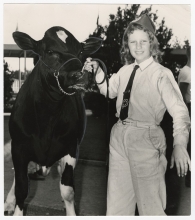
Last December, Emily Lin, Head of Digital Curation and Scholarship at UC Merced Library, announced an exciting new partnership between the Library and the Merced County 4-H Club. After the Library acquired the University of California Cooperative Extension (UCCE) archives, a key objective has been to share this incredible resource with the community. With this aim in mind, we developed the 4-H StoryMapping Project. The project seeks youth engagement with the digitized items of the UCCE archival records for Merced County, a vast collection that dates back to 1916 and includes primary source documents and photographs about irrigation, fires, home economics, crops, dairy, and much more. A large portion of the collection is 4-H material that highlights the extraordinary work the organization has done to create experiences for youth in which they “learn by doing.” Below are just a few of the photographs from the UCCE collection that document 4-H-ers in Merced County.
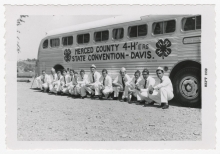


1. 4-H members in front of bus, 1959

2. 4-H girl and cow, c. 1967

3. Boys give presentation, c. 1957

4. Group of girls, c. 1957

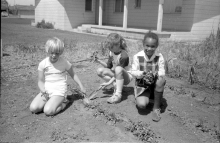
5. Radish garden, undated

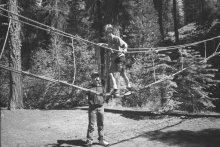
6. Boy standing on rope, 1990

The images show youth participating in a variety of activities that include gardening, livestock shows, rope courses, poster presentations and more. In the midst of the Covid-19 global pandemic, these types of experiences are on hold until it is safe again to gather collectively. So, the 4-H Storymapping Project comes at the perfect time. Project meetings are conducted on Zoom, and content providers from the UCM Library and the Spatial Analysis & Research Center (SpARC) conduct lessons through online tutorials, aimed to engage our youth participants in local historical research – just like historians! 

As the Project Archivist for UC Merced’s California Agricultural Resources Archive (CARA), I have shared with our youth participants the ways that primary source documents can illuminate obscure and forgotten historical information and artifacts. After conducting searches in the digital collection, they have decided on research topics for their StoryMaps, a digital platform that allows users to integrate text, documents, audio-visual materials, and maps to construct historical narratives.

Youth participants use online teaching tools to think about research areas found in CARA.        

UC Merced Library staff help 4-H youth to take broad themes found in the UCCE collection and develop research questions for their StoryMaps.

Participants will have the opportunity to present their final projects to 4-H leaders and community members through online venues. We are excited to see what they come up with. Stay tuned for updates!


One Library Search with the Power of Ten

Mon, February 8, 2021 3:40 PM
One Library Search with the Power of Ten- UC Library Search News Release, February 2021
 
On July 27, 2021, all ten campuses of the UC system will be connected through UC Library Search, a unified library discovery and borrowing system. UC Library Search features the following:
  • The ability to search UC Merced’s local library collection and the collections of all ten UC libraries in the same system at the same time;
  • Borrow and renew materials from any library in the UC system without needing to retype your library card number or enter a user name;
  • Locate millions of print and online books, journal articles, and other content.
The enhanced features of UC Library Search will replace Melvyl as the UC-wide library catalog search tool. As a single, unified system, UC Library Search will offer powerful tools to help the UC Libraries make data-informed decisions around collections development and new services for library users.
 
Stay tuned to find out more information about UC Library Search in the coming months by visiting the official UC Library Search website
If you have further questions about UC Library Search, please contact Olivia Olivares, Instruction & Outreach Librarian, oolivares@ucmerced.edu.  

Tracing Agricultural History in the Archives

Fri, February 5, 2021 6:30 AM
Author: 

The University of California Cooperative Extension (UCCE) Records for Merced County span well over one hundred boxes of documents and photographs and have a physical footprint of about 70 linear feet in the UC Merced Library. Merced County Cooperative Extension recordsThat’s several ranges of library shelves, and yes, they are stored in our “archives vault.” That’s one of the differences between a library collection, where anyone can pick up a book from a shelf, and an archive, where a researcher typically schedules an appointment and identifies specific boxes to look at ahead of time. So how do you know what you can find in the archives? And why would someone want to access the archives?
For starters, yes, you can always contact the UC Merced Library to learn more about our collections and discuss a research question you may have. The library even offers a 24/7 chat reference service as part of the larger network of UC Libraries. Let’s say you are a fourth- or fifth-generation Merced farmer and you’re wondering if there is any information about your family farm in the archives. While there may not be a direct path to answering that question, knowing what the archives contain can direct you to where to look.

The Merced County Cooperative Extension records, along with other UCCE county records archived at UC Merced Library, have what is called a “finding aid” published in the Online Archive of California. This online guide provides information about the scope and background of the collection as well as an outline of how it is organized. Since these are the organizational records for the county Cooperative Extension office, they reflect the work and activities of that organization.

As a general principle, archivists take care to respect the original order of files based on the theory that the original organization may reflect relationships and context that are important to retain. In other words, when we receive a collection, we do not simply begin to organize materials alphabetically, by chronology, or by subject. Whether they are the personal files of an individual or the files from an organization, we take into account their grouping and sequence. In an organization, for example, records may be created and organized by department or by key functions. These groupings can help a researcher understand the structure and development of that business or organization. Sometimes, however, materials end up boxed or stored away without much thought to organization. Imagine if someone dumped all of their photos randomly into a box. If later the box is given to an archives, it will be up to the archivist to try to make sense of the contents and arrange them in such a way that is useful to a researcher.

The Merced UCCE records contain administrative files of annual, monthly and weekly reports from 1917-1974, and trial reports from roughly that time period. They also contain the files of individual farm advisors, some of whom inherited or subsumed the files of previous advisors into their files. For the most part, these farm advisor files are organized by specialization or research topics—for example, fruit trials, pomology, soil—keeping their original groupings. Additionally, there are files that were not associated with a particular advisor, but are grouped by subject or format, such as crops, livestock, 4-H, and audiovisual materials.

Uncovering information about a particular farm would take digging: if you knew about specific activities such as participation in a project or crop trial, you could hone in on records by time period or crop. The historic narrative reports often mention the activities of specific members of the Farm Bureau, and especially in the early years it is interesting to note those who had a prominent role.

Clip from 1921 narrative report

The 1921 narrative report of the county agent lists members of the Cottonwood center and their projects.

So what are some other reasons for accessing the archives? Perhaps you have an interest in a particular crop and the varieties that were tried in the region or the growing practices or treatments used. A researcher could also trace the historical development of a particular industry in the county, such as dairy, through the reports and research documented in these records.

The 1921 narrative report of the county agent is an example of one reason why archives can offer interesting and valuable information. While the earliest volumes of the Merced County Farm Bureau Monthly are available online, the published information does not disclose the political struggles and organizational challenges faced in those early years, which county agent J.F. Grass so frankly writes about in his report:

Three school fights, two church fights, and the differences existing at Delhi has caused a splitting up to some extent of these centers, some of these getting down to personal quarrels. It is therefore surprising that under all these things the unity of the Merced County Farm Bureau is as strong as it is.

Primary source documents in an archive can offer a different perspective on a subject, and often a more direct or personal point of view than what’s available in the public record.

Now digitized, however, these historical perspectives are available for anyone curious or interested in seeing the fuller picture.

For more information: cara.ucmerced.edu

Access Alert - OCLC

Thu, February 4, 2021 9:50 AM

Beginning Sunday, February 7th at 5:30am until 9am Pacific Time, OCLC will be performing systems maintenance which may cause sporadic interruptions and delayed response times for online catalog services. We apologize for any inconvenience and hope this interruption will create minimal disruption to our users’ research.

UC Merced Library Participating in UC Love Data Week with Series of Workshops

Wed, January 27, 2021 1:40 PM

UC Love Data Week- Monday, February 8, 2021 - Friday, February 12, 2021

UC Love Data Week is a week-long offering of presentations and workshops focused on data access, management, security, sharing, and preservation. All members of the University of California community are welcome to attend.

You can read about the workshops and register for individual workshops on the website: https://uc-love-data-week.github.io

Make sure to register with your UC-campus email. Follow the event on Twitter and Instagram using #LoveData21.

Spring 2021 Library Workshops

Tue, January 26, 2021 9:45 AM

Spring 2021 Library and SpARC Workshops 

The spring semester is underway and we have a full slate of workshops for a wide range of topics like using citation management tools, GIS essentials, accessing & evaluating online health information and more.

Registration is open and all workshops will be presented over Zoom. You will receive a Zoom link and passcode with your registration email. Visit our Events Calendar for more details or click on the links below. 

Wednesday, January 27, 2021: 12:30pm-2:00pm
GIS Essentials Workshop
Instructor: Erin Mutch, SpARC
 
Tuesday, February 2, 2021- Watch the Recording 
Thursday, March 11, 2021: 1:00pm-1:20pm
Start Your Research Smart (20 Minute Workshop)
Instructor: Elizabeth McMunn-Tetangco
 
Wednesday, February 3, 2021: 12:30pm-1:30pm
Web Mapping-Virtual Workshop
Instructor: Erin Mutch, SpARC
 
Friday, February 5, 2021
Wednesday, March 17, 2021: 11:00am-11:50am
Manage Your Research with Mendeley
Instructor: Elizabeth Salmon
 
Tuesday, February 9, 2021- Watch the Recording 
Introduction to Locating Secondary Data & Searching Data Repositories: Social Sciences Edition
Instructor: Elizabeth Salmon
 
Wednesday, February 10, 2021: 12:30pm-1:30pm
Story Map-Virtual Workshop
Instructor: Erin Mutch, SpARC
 
Friday, February 12, 2021:10:00am-12:00pm
Web Scraping in R
Event Contacts: Derek Devnich & Derek Sollberger
 
Thursday, February 18, 2021-Watch the Recording 
Using Zotero to Manage Your Research
Instructor: Elizabeth McMunn-Tetangco
 
Thursday, February 18, 2021: 2:30pm-2:50pm
Thursday, March 11, 2021: 4:00pm-4:20pm
Using Flipster to Read Your Favorite Magazines Online (20 Minute Workshop)
Instructor: Sara Davidson Squibb
 
Tuesday, February 23, 2021- Watch the Recording
Wednesday, March 31, 2021: 12:30pm-12:50pm
Three Strategies for Searching (20 Minute Workshop)
Instructor: Elizabeth McMunn-Tetangco
 
Tuesday, February 23, 2021- Watch the Recording
Choose a Citation Management Tool
Instructors: Sara Davidson Squibb, Elizabeth Salmon, Elizabeth McMunn-Tetangco
 
Wednesday, February 24, 2021: 12:30pm-2:00pm
Desktop GIS (ArcGIS Pro and Desktop)
Instructor: Erin Mutch, SpARC
 
Friday, February 26, 2021- Watch the Recording
Thursday, April 1, 2021: 11:30am-12:20pm
Manage Your Research with RefWorks
Instructor: Sara Davidson Squibb
 
Thursday, March 4, 2021- Watch the Recording
Wednesday, March 31, 2021: 11:30am-11:50am
Access the New York Times (Web Version) (20 Minute Workshop)
Instructor: Sara Davidson Squibb
 
Thursday, March 4, 2021- Watch the Recording
Intro to DOIs (Digital Object Identifiers) (20 Minute Workshop)
Instructor: Sara Davidson Squibb
 
RESCHEDULED EVENT
Python for GIS Using Jupyter Notebooks
Instructor: Erin Mutch, SpARC
 
Wednesday, March 10, 2021- Watch the Recording
Monday, April 12, 2021: 3:00pm-3:30pm
Avoiding Plagiarism: When to Cite, When to Paraphrase
Instructor: Olivia Olivares
 
Thursday, March 11, 2021- Watch the Recording
Understanding MLA 8th Edition
Instructor: Sara Davidson Squibb
 
Friday, March 12, 2021: 1:00pm-1:50pm
Locating & Evaluating Online Health Information
Instructor: Elizabeth Salmon
 
Monday, March 22, 2021-Wednesday, March 24, 2021 (Must register to attend all 3 days)
Geospatial Data in R (Software Carpentry Workshop Series)
Instructors: Erin Mutch & Derek Devnich
 
Friday, April 16, 23 and 30, 2021
Library Carpentry (Three-Week Series)
Instructor: Derek Devnich
 
Wednesday, April 28, 2021: 12:30pm-1:30pm
Open Source GIS (QGIS)
Instructor: Erin Mutch, SpARC
 
RESCHEDULED EVENT
Thursday, April 29, 2021: Watch the Recording 
Faculty Author Series: Dr. Sidra Goldman-Mellor
Event Contact: Elizabeth McMunn-Tetangco
 
 
INFORMATION SESSIONS:
 
Zero-Cost Course Materials Faculty Information Session
Wednesday, April 14, 2021- 12:00pm-1:00pm
Audience: Faculty
 
Improving Wikipedia Pilot Project : Authentic Inquiry & Student Research Assignments Information Session
Friday, April 23, 2021- 11:00am-12:00pm
Audience: Faculty, Staff, Graduate Students


Access Alert - ProQuest

Mon, January 25, 2021 1:15 PM

Beginning Saturday, January 30th at 7pm Pacific Time through Sunday, January 31st at 3am Pacific Time, ProQuest platforms will be undergoing scheduled maintenance. ProQuest content and platforms such as Ebook Central ebooks, ProQuest Congressional database and others may be unavailable during this time. We apologize for any inconvenience and hope this interruption will create minimal disruption to our users’ research.

UC Reaches Open Access Agreement with Springer Nature- A Letter to the Academic Community from University Librarian, Haipeng Li

Wed, January 20, 2021 9:35 AM
Dear UC Merced Academic Community:
 
Happy New Year!
 
We are excited to announce that the University of California has entered into a transformative open access agreement with Springer Nature. This agreement will allow UC authors to make their research published in Springer Nature journals freely available for anyone to read. 
The first phase of the agreement will support UC authors whose articles are accepted by journals in the Springer portion of the Springer Nature portfolio, including SpringerAdis, and Palgrave Macmillan titles, as well as academic journals on nature.com.    
 
Here's how the new process will work: 
 
After January 4, upon acceptance of an article, UC-affiliated corresponding authors (faculty, lecturers, staff, and graduate students) will, by default, have their article designated for open access publishing, with funding support from the UC libraries. The support will work in this way: 
 
  • For authors whose articles are accepted in journals from the Springer portion of the Springer Nature portfolio and who choose open access publishing, the UC libraries will automatically pay the first $1,000 toward the open access fee (called an Article Processing Charge or APC). 
  • Authors who do not have research funds available can request that the UC libraries pay the entire open access fee, ensuring that lack of research funds does not present a barrier for UC authors who wish to publish open access in these journals.  
 
As with other similar publishing agreements, authors may opt out of open access publishing if they prefer to publish their article on a subscription (pay-to-read) basis. 
The integration of Nature-branded journals into the agreement is expected in 2022.  
 
More detail about the agreement is available on these pages: 
If you have any questions about any part of this process, please contact Jerrold Shiroma at the UC Merced Library at jshiroma@ucmerced.edu
 
- Haipeng Li, University Librarian
 

Access Alert - OCLC

Tue, January 12, 2021 10:45 AM

Beginning Saturday, January 16th at 11pm through Sunday, January 17th at 6:30am Pacific Time, OCLC will be performing systems maintenance which may cause sporadic interruptions and delayed response times for online catalog services. We apologize for any inconvenience and hope this interruption will create minimal disruption to our users’ research.

Access Alert - RefWorks

Thu, December 10, 2020 5:35 PM

Beginning Saturday, December 19th at 8pm until 10pm Pacific Time, RefWorks will be unavailable due to scheduled maintenance. We apologize for any inconvenience and hope this interruption will create minimal disruption to our users’ research.

Pages

Subscribe to Library News