Skip to content Skip to navigation

Library News

Access Alert - OCLC

Tue, April 20, 2021 10:55 AM

Beginning Saturday, April 24th at 9pm through Sunday, April 25th at 4am Pacific Time, OCLC will be performing systems maintenance which may cause sporadic interruptions and delayed response times for online catalog services. We apologize for any inconvenience and hope this interruption will create minimal disruption to our users’ research.

Women's Studies Archive Now Available

Thu, April 8, 2021 2:50 PM


UC Libraries now have access to two modules - Issues & Identities and Voice & Vision -- in the Women's Studies Archive. Hosted at Gale Primary Sources, this archive showcases women's voices and feminism's evolution during the 19th and 20th centuries. Content is global and includes manuscripts, newspapers, periodicals, memoirs, pamphlets, personal papers and more from libraries & archives including the British Library, Swarthmore College, New York University, The National Archives at Kew, University of California Santa Barbara, and the American Antiquarian Society.

Sample collections include the Grassroots Feminist Organizations featuring files (1960s-1990s) from women's centers and feminist organizations in Boston and San Francisco. The Women's Trade Union League (WTUL) and Its Leaders highlights women's activism in the first of the 20th centuries and includes the papers of Margaret Dreier Robins who led the WTUL from 1907 to 1922. The National Network of Hispanic Women Archives, from UCSB, offer administrative files, publications, photographs and ephemera from the Network - a non-profit focused on advancing Hispanic women's leadership in private public sectors from the 1970s through the 1990s.

The archive is available in the Library's database listing. In addition to searching the archive, you can browse all 30 collections or navigate to specific publications.


Preserving the Film Reels of the University of California Division of Agriculture and Natural Resources

Thu, April 8, 2021 2:50 PM

In addition to archiving the records of county Cooperative Extension records such as Merced’s, the CARA (California Agricultural Resources Archive) project at UC Merced is also preserving historical reports and film from the University of California Division of Agriculture and Natural Resources (UCANR), the statewide organization that oversees UCCE county offices and personnel. In 2019, we accepted several boxes of 16mm film reels from the UCANR statewide office. Produced by UCCE personnel throughout California, the films date from 1953 to 1979 and cover UCANR activities such as the 4-H youth development program, food and nutrition education, wildland management, the ag industry, animals, and adolescent health.
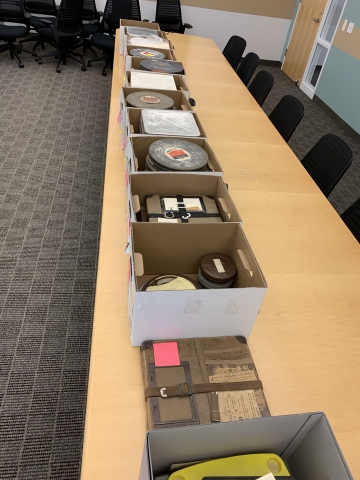
Boxes of film reels from the University of California Division of Agriculture and Natural Resources, UC Cooperative Extension Records.

In previous columns we’ve discussed how archivists approach organizing records. When the library acquires collections, the archivist first conducts a survey of the materials making note of major topics, themes, and how the records are organized. For example, did the material come from the offices of a certain farm advisor or home demonstration agent? This step helps the archivist to process and arrange the materials in a way that makes them easily accessible to the public. In addition to these concerns, the archivist must also take into account the physical properties of the materials. Doing so can help determine the approximate date of records that may otherwise be undated. Some mediums, in particular audiovisual items, are now obsolete and require older technologies to listen to or view them. Archivists need to be familiar with different formats and media types and how to handle them—both to preserve them and to provide access to researchers.
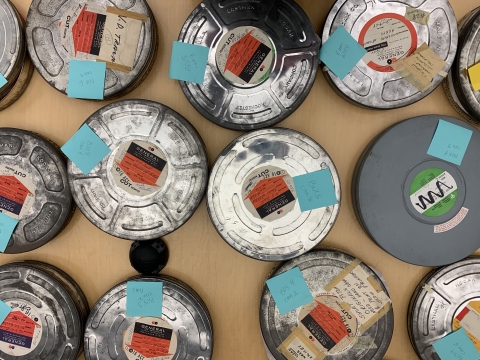
Film reels are laid out on a table and organized by title.

While surveying this collection of over 100 UCANR films, the archivist documented essential details such as the type of canister, the diameter of the reels, and condition of the medium, as well as titles, dates, transcriptions and other production information. Doing this work required opening each film can, and the vinegar smell was very strong! Why? The base of 16mm films made during this time period is cellulose acetate, which carries with it certain preservation concerns. If the reels are not stored in the right environment where temperature and humidity are controlled, and if they are not housed in archival quality boxes and cases, the films are at great risk of developing what is called “vinegar syndrome.” This form of deterioration occurs when acetic acid is released from the film base, leading to embrittlement, shrinkage, and bubbling of the film. Not only does this affect the particular film omitting the acid, but when off-gassing occurs, it can damage any objects in its vicinity. The strong smell of vinegar is an indicator that the process has started. Once vinegar syndrome begins, it is irreversible; if the effects of vinegar syndrome go too far, it becomes impossible to play the media or even transfer it to a digital file format.
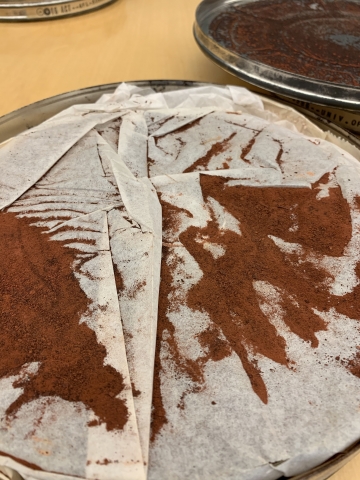
Red powder flaking off film cans
One aspect of deterioration emanates from the metal cans which can rust and cause a red powder to flake off onto the object.

Clearly, these reels were in various states of deterioration and needed immediate attention so their contents would not be lost. However, working with such film requires specialized equipment and trained experts to digitize—all of which comes at an expense. Since we did not know beyond the little information on the cans what the contents of these films were, nor the quality of playback once digitized, we decided on a set of films that would constitute a pilot for preservation and digitization. We worked with the MediaPreserve, a company based in Cranberry Township, PA with extensive experience working with universities, libraries, and other cultural heritage institutions to preserve and digitize such materials. Their experienced specialists helped to guide us through the steps needed to make these films last, including housing in archival quality film cans and digitizing them into sustainable file formats.

MediaPreserve lock boxes for shipping films
The MediaPreserve sent us their own lock boxes so that the films are protected as they make their way to their offices in Cranberry Township, Pennsylvania.

So far, we have already received the digital files for the first three films of our pilot, and they are high-quality professional productions. One film, titled 4-H Trail, was produced in 1963 to illustrate the extensive range of activities undertaken by 4-H club members in California, with scenes from local club meetings, family farms, camps, and field days accompanied by singing from a county 4-H club chorus. Another film, What’s in Food? (1962) is a production of the “Homemaker’s Notebook” with UCCE home nutritionist Marion Tate presenting information about healthy eating. The last of the three was chosen because of the intriguing title, “Muppetts” on the film’s canister. It turned out to be a series of short clips from 1975 titled Children’s Nutrition (Candy) produced for the KTVU station that feature puppets—not to be confused with the widely known Muppets—speaking about the benefits of eating healthy foods like fruits and vegetables, instead of candy.

We are seeking the funds to support the digital preservation of the other films in the collection. The range of titles include Modern irrigation equipment (1964), Tomatoes (undated), Hills of Grass (Madera County, undated), California deer (1965), and Cows n’ kilowatts 4-H. In the meantime, you can see the films digitized from our pilot on Calisphere.

We look forward to digitizing and sharing more of these films with you.


Access Alert - OCLC

Tue, April 6, 2021 9:45 AM

Beginning Saturday, April 10th at 9pm through Sunday, April 11th at 2am Pacific Time, OCLC will be performing systems maintenance which may cause sporadic interruptions and delayed response times for online catalog services. We apologize for any inconvenience and hope this interruption will create minimal disruption to our users’ research.

Access Alert - OCLC

Tue, March 30, 2021 10:00 AM

Beginning Saturday, April 3rd at 11pm through Sunday, April 4th at 2am Pacific Time, OCLC will be performing systems maintenance which may cause sporadic interruptions and delayed response times for online catalog services. We apologize for any inconvenience and hope this interruption will create minimal disruption to our users’ research.

Access Alert - OCLC

Tue, March 30, 2021 9:55 AM

On Thursday, April 1st from 7am to 8am Pacific Time, OCLC will be performing systems maintenance which may cause sporadic interruptions and delayed response times for online catalog services. We apologize for any inconvenience and hope this interruption will create minimal disruption to our users’ research.

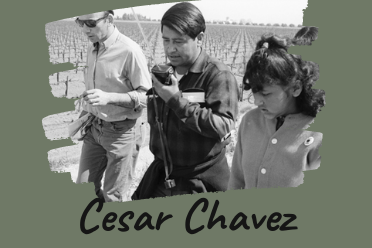
Cesar Chavez Photographs Discovered In Ernest Lowe Collection

Mon, March 29, 2021 10:40 AM

Photo: Courtesy of the Ernest Lowe Collection, UC Merced Library

Cesar Chavez Photographs Discovered In Ernest Lowe Collection

As part of the Ernest Lowe photography collection acquired by the UC Merced Library last year, in partnership with the UC Merced Center for the Humanities, over 2,700 photographs and 5,000 film negatives of migrant farm workers' experiences were cataloged and digitized. Of these photos, historical and important images of civil rights activist Cesar Chavez were discovered. Read the full article by UC Merced News.

Coming Soon: UC Library Search

Thu, March 18, 2021 11:15 AM

Melvyl debuted in 1981, before most of our current students (and some of our faculty!) were born. Melvyl revolutionized the UC library system, allowing researchers to find books at other UC campuses through computer terminals on their own campuses.

Behind the scenes, however, Melvyl relied on a complex patchwork system that connected multiple catalogs and databases in order to coordinate interlibrary loans and full-text access. As several of these systems approached the end of their life spans, the UC Libraries recognized the technical unsustainability and inherent risks associated with keeping the Melvyl system. Consequently, about four years ago, the project of making UC Library Search a reality commenced.

UC Library Search will vastly improve the user experience of faculty, students, and researchers worldwide who need to access collections across the University of California system. Rather than using Melvyl, which linked separate catalogs from different institutions, all of the University of California libraries will now be part of one unified discovery tool. 

Here's a preview of the new logo for UC Library Search:

UC reaches open access agreement with Elsevier

Tue, March 16, 2021 8:40 AM

After more than two years of negotiations, this morning the University of California announced a transformative open access agreement with Elsevier, the world’s largest academic publisher. This successful outcome is the result of UC’s faculty, librarians and university leadership coming together to stand firm on our goals of making UC research freely available to all and transforming scholarly communication for the better.

The new four-year agreement will go into effect on April 1, 2021, restoring UC’s direct online access to Elsevier journals while accomplishing the university’s two goals for all publisher agreements:

(1)    Enabling universal open access to all UC research; and 
(2)    Containing the excessively high costs associated with licensing journals.

These goals directly support UC’s responsibility as a steward of public funds and its mission as a public university to make its research freely available. The agreement with Elsevier will double the number of articles covered by UC’s open access agreements.

What the agreement means for the UC community

●    Reading access: Effective April 1, UC will regain access to articles published in Elsevier journals the libraries subscribed to before, plus additional journals to which UC previously did not subscribe. 

●    Open access publishing in Elsevier journals: The agreement will also provide for open access publishing of UC research in more than 2,500 Elsevier journals from day one. The Cell Press and Lancet families of journals will be integrated midway through the four-year agreement; UC’s agreement is the first in the world to provide for open access publishing in the entire suite of these prestigious journals.

●    Library support for open access publishing: All articles with a UC corresponding author will be open access by default, with the library automatically paying the first $1,000 of the open access fee (also known as an article publishing charge or APC). Authors will be asked to pay the remainder of the APC if they have research funds available to do so. 

●    Discounts on publishing: To lower those costs even further for authors, UC has negotiated a 15 percent discount on the APCs for most Elsevier journals; the discount is  10 percent for the Cell Press and Lancet families of journals.

●    Full funding support for those who need it: To ensure that all authors have the opportunity to publish their work open access, the library will cover the full amount of the APC for those who do not have sufficient research funds for the author share. Authors may also opt out of open access publishing if they wish.

The economics of the deal

As with UC’s other recent open access agreements, the Elsevier agreement integrates library and author payments into a single, cost-controlled contract. This shared funding model enables the campus libraries to reallocate a portion of our journals budget to help subsidize authors’ APCs — assistance that makes it easier and more affordable for authors to choose to publish open access. 

Even with library support, authors’ research funds continue to play a critical role. This funding model only works if authors who do have funds pay their share of the APC. 

In the other open access agreements UC has implemented, we are already seeing a significant proportion of authors paying their share of the APC. If this promising trend continues, UC can blaze a path to full open access that is sustainable across ever more publishers.

Partnering with publishers of all types and sizes

Meanwhile, the university continues to forge partnerships with publishers of all types and sizes. In addition to Elsevier, UC also signed open access agreements with three more not-for-profit and society publishers this month — The Company of Biologists, The Royal Society and Canadian Science Publishing. These agreements are in addition to those secured previously with Springer Nature, Cambridge University Press, society publisher ACM, and native open access publishers PLOS and JMIR.

Ultimately, UC’s goal is to make it possible for all authors to publish their work open access in whatever journal they choose — providing broad public access to the fruits of UC’s research. This month, we have made a tremendous stride in that direction. We know that this has been a lengthy process and we thank you for your patience and support as we worked to reach this outcome.

If you have questions, please don’t hesitate to contact Jerrold Shiroma, jshiroma@ucmerced.edu, at any time.

Haipeng Li, University Librarian
Gregg Camfield, Executive Vice Chancellor and Provost
Robin DeLugan, Academic Senate Chair
Maria DePrano, Committee on Library and Scholarly Communications Chair
 

New and Improved Library Chat Service: LibChat

Mon, March 15, 2021 4:45 PM

LibChat 24/7 Library Chat Service is Here!

Library chat has been recently revamped, and includes several new features to help students, faculty, staff, and visitors. 

UC users now have the option to participate in Zoom screensharing with UC libraries, speeding up the process and allowing chat librarians to use visual aids to help patrons. In addition, users can now email themselves chat transcripts at any time. Chat is available to anyone on the Library's website, and can answer questions about finding articles, accessing articles, creating citations, using library services, and more. 

Library chat moved from the QuestionPoint platform to LibChat in June, allowing for better, more streamlined service. 

You can click here to try out chat, or find links on multiple Library webpages. 

Pages

Subscribe to Library News