Skip to content Skip to navigation

Digitization

Request Course Resources for Fall 2025

Tue, July 8, 2025 2:10 PM

Do you need to make supplemental course materials available to your students?

Course resources is a service the Library offers to make course-related materials available to your students. Print materials can be made available at the Library for a 2-hour loan period upon request. 

Would you like to make video materials available to your students?

The Library offers digitation services for AV materials, including eligible DVDs. Video content digitized by the Library is made available in CatCourses through the Kaltura Canvas tool. 

Requests can be submitted at any time and will be processed in the order they are received. For more information and to submit a request, see our Course Resources guide

40 Years of AIDS: "They Were Really Us" exhibit on display through December 2021

Wed, November 10, 2021 12:00 AM

"They Were Really Us" exhibit at Kolligian Library

"They Were Really Us": The UCSF Community’s Early Response to AIDS at the UC Merced Library chronicles 40 years of the AIDS crisis in photos, essays, and research materials. The exhibit title is based on a statement made by Dr. Paul Volberding in the documentary, Life Before the Lifeboat: San Francisco’s Courageous Response to the AIDS Outbreak:

The patients were exactly our age… all those other ways that we tend to separate ourselves meant very little when you realize that the patients had gone to the same schools, they listened to the same music, they went to the same restaurants. So they were really us… which added to the commitment that I think all of us had.

Drawing from the AIDS History Project collections preserved in UCSF’s Archives and Special Collections, “They Were Really Us" sheds light on how UCSF clinicians and staff addressed HIV/AIDS from its outbreak in the 1980s to the foundation of the AIDS Research Institute in 1996. "They Were Really Us" exhibit at Kolligian Library

The exhibit could hardly be more timely now--parallels between the HIV/AIDS epidemic and the COVID-19 pandemic are striking, from the medical professionals who were at the forefront of defining what was at first a mysterious disease, to the community organizations combating associated stigma and misinformation, to public campaigns preventing transmission by promoting practices like condom-wearing. "They Were Really Us" is an inspiring display documenting the medical successes and advances in activism that continue to impact the world today. 

A recently aired podcast from Berkeley Remix, "First Response: AIDS and Community in San Francisco," is an audio complement to “They are Really Us.” This six series-podcast, produced by The Oral History Center at UC Berkeley, is about the politics of the first encounters with the AIDS epidemic in San Francisco. It draws from thirty-five interviews conducted in the 1990s with Sally Smith Hughes, historian of science at the Bancroft Library and author of The Virus: A History of the Concept. The featured interviews focus on the early years of epidemic, when the first reports emerged of an unknown disease that was killing gay men in San Francisco, to 1984 and the development of a new way of caring for people in a hospital setting.

With funding from @NEHgov, we partnered with UCSF Library, The GLBT Historical Society & San Francisco Public Library to make 160,197 pages of AIDS history documenting the early days of the epidemic available online. In concluding the project, "They Were Really Us" was originally installed at UC Merced Library for an opening in Spring 2020, but ironically, the COVID-19 pandemic led to the library's closure. A digital version of "They Were Really Us" was published on Calisphere in July 2020. We are continuing to digitize AIDS collections from UCSF with support from Network of the National Library of Medicine - Pacific Southwest Region. 

See "They Were Really Us" at UC Merced Kolligian Library through December 2021.

Calisphere Soars Past Two Million Digital Primary Resource Items!

Thu, August 5, 2021 9:45 AM

Calisphere now includes over 2 million digital primary sources from 300+ organizations in the State of California! Calisphere's collections include those digitized at the UC Merced Library including the UC Cooperative Extension Archive, Ernest Lowe Photography Collection, and Dunya Ramicova Costume Design Collection. See Special Collections & Archives

As part of the celebration, the California Digital Library has created free virtual backgrounds from selected images in Calisphere. See the full press release below from CDL. 


Calisphere soars past two million digital primary resource items!

August 4, 2021
Author: Christine Kim
Newsletter
Publishing, Archives, and Digitization

Special Collections

We are delighted to announce that Calisphere now provides access to over two million historical images, texts, recordings, and other primary resources from the state of California’s remarkable digital collections. Explore early maps of the world; photographs from historical newspapers; paintings reflecting periods of cultural significance; personal journals and diaries charting new frontiers; political posters calling for decades of social and political change; and interviews with and oral histories of the citizens of this state. Visit Calisphere to access this openly-available, statewide aggregation of digitized resources from over 300 participating institutions and delve into the stories that have shaped California throughout its history.

We would like to express our gratitude to our partner organizations throughout California–libraries, archives, museums, historical societies, and other cultural heritage organizations–for their ongoing participation in contributing content that helps shape Calisphere as a valuable public resource for teaching and learning. Learn more about the shared commitments, values, and community practices that guide us and our contributing partner organizations.

And stay tuned for additional news and updates as the breadth and depth of this statewide aggregation continues to grow.

Celebrate with us!

We’re celebrating this significant milestone with a collection of free “virtual meeting” backgrounds to share with colleagues, students, researchers, and friends. Choose from a variety of iconic, historical, or whimsical images to set as your virtual meeting background.
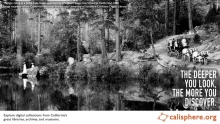
People riding in a Stella Lake Stage, operated by Washburn Stage Line, Wawona, California, 1890. Image courtesy: California Historical Society and University of Southern California Digital Library.
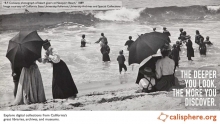
B.F. Conaway photograph of beach goers at Newport Beach, 1889. Image courtesy: California State University, Fullerton, University Archives and Special Collections.
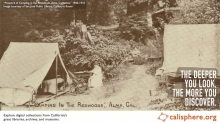
Postcard of Camping in the Redwoods, Alma, California, 1900-1910. Image courtesy: San José Public Library, California Room.
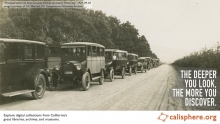
Transportation to Inter-County Walnut Growers’ Field Day, 1927-09-03. Image courtesy: UC Merced, UC Cooperative Extension Archive.

Feel free to download the images and use them as meeting backgrounds. 

Check out our outreach tips and tools for sharing Calisphere with others, including a new embeddable video resource.

Thank you

The magnitude of this ever-growing collection was made possible by a multi-year grant from the U.S. Institute of Museum and Library Services funds under the provisions of the Library Services and Technology Act (LSTA). Administered in California by the State Librarian, this financial support has enabled us to explore and quickly harvest new digital collections from across the state.

We also thank California Revealed, a California State Library initiative to help California’s public libraries and local heritage groups digitize, preserve, and provide online access to archival materials (books, newspapers, photographs, audiovisual recordings, and more) that expand our understanding of the history of the Golden State.


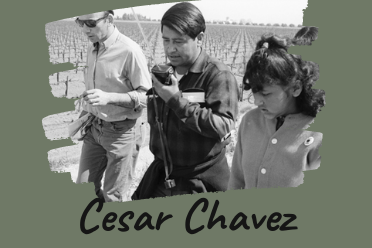
Cesar Chavez Photographs Discovered In Ernest Lowe Collection

Mon, March 29, 2021 10:40 AM

Photo: Courtesy of the Ernest Lowe Collection, UC Merced Library

Cesar Chavez Photographs Discovered In Ernest Lowe Collection

As part of the Ernest Lowe photography collection acquired by the UC Merced Library last year, in partnership with the UC Merced Center for the Humanities, over 2,700 photographs and 5,000 film negatives of migrant farm workers' experiences were cataloged and digitized. Of these photos, historical and important images of civil rights activist Cesar Chavez were discovered. Read the full article by UC Merced News.

100 Years Ago: Improving Life in the Farm Home

Fri, December 18, 2020 12:00 PM
Author: 

Last month, I introduced the history of the development of the Merced County Farm Bureau as documented in the early reports of the county agent. These reports, as well as historical photographs, are now freely available in digital form through Calisphere. Working alongside the county agent was a home demonstration agent who was responsible for organizing activities to solve problems and improve practices which affected “physically, socially, or economically the homes of the community.” In December 1920, after her first year in the county, agent Mary Van Camp reported that fifteen centers had been organized in the county with a membership of 401 women engaged in a program of work for each farm home department center. 

What is striking to me about her report is the consistent emphasis on the development of local leaders. It was up to each center to decide what problems they wanted to raise attention to and promote training to address. Across the county, the “problems” identified were clothing, food, and improved health and sanitation. While the agent’s role was to advise and provide demonstrations, she describes her role as putting “as much confidence in the ability of the local leader as she could[,] checking methods when undesirable and praising where methods used were good.” That speaks volumes about the spirit behind Cooperative Extension and its approach. “It is interesting to note,” Van Camp writes, “that each different leader is planning the work as best fits her environment.” Her report records insights into the different needs of each community, how sharing models and practices can inspire local initiatives, and how to best foster and support locally-led problem solving.

The Start of School Hot Lunches

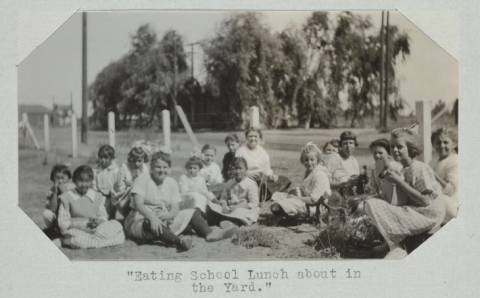
After a child feeding demonstration was conducted in a one room rural school in Livingston, local leadership organized to improve the school lunch situation. Teachers, a local nurse and physician, as well as the county superintendent of schools, worked together to introduce hot lunches and improve sanitation at the schools. With a number of photographs, Van Camp makes the point that children no longer needed to sit on the ground outside to eat their lunches. Instead, in cold weather children were served a hot dish, and “pupils mob the home demonstration agent on the road to tell her they have gained a pound.”

Eating school lunch about in the yard.

Food Preservation and Clothing Techniques

We may not have expected that 2020 would bring a renewed interest in canning (news reports have noted shortages in canning supplies) as well as other at-home activities such as sewing and knitting. A hundred years ago, home demonstration agents played a key role in showing homemakers how to safely preserve food and how to make their own clothing efficiently. That knowledge would become even more valuable as communities later weathered the Great Depression and shortages during the Second World War.

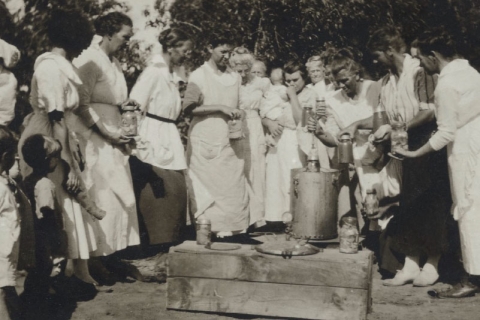
Van Camp reports on demonstrations on “cold pack sterilization, pressure cooker, water bath and steam bath” methods for canning vegetables and meats. A Mrs. L’Hommadieu of Stevinson even hosted a demonstration at her home on the use of a canning retort, where a 35 lb. pig was preserved alongside eight quarts of beans. 

Demonstration on the use of a canning retort.

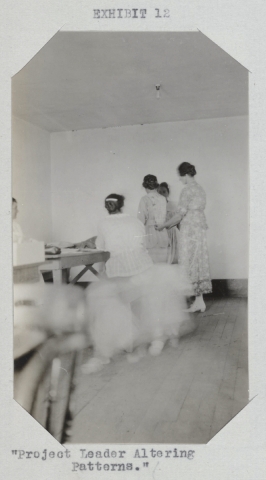
In another photograph in the report, she depicts a project leader demonstrating how to alter dress forms for clothing. A blur of movement in the foreground of the photo are the toddlers in the room watching as well.

Project leader altering patterns.

For those interested in learning more about the history of canning techniques, the National Agricultural Library has a wonderful digital exhibit on The Evolution of Home Canning Practices

This spring, the UC Merced Library is teaming up with Merced 4-H to inspire local youth to create their own digital exhibits and tell their own local stories. We are accepting registration for a county-wide project to begin in January. Students 8th grade and up will learn to use digital archives, Arc GIS Story Map software, and other digital tools. We are excited to see what students come up with and what histories they uncover!

This article was published in the December 2020 issue of the Merced County Farm News.

Calisphere Expands Digital Collections Across the UC

Mon, October 12, 2015 12:00 AM

UC Merced’s Panorama publication recently highlighted the UC Libraries Digital Collection and UC Merced’s contributions to this project.  The project includes a new version of Calisphere with a substantial increase in content with approximately 50 new collections from UC libraries.  The project has also created the infrastructure needed to make these collections visible in the Digital Public Library of America (DPLA).

Full Article (no longer available): Calisphere Expands Digital Collections Across the UC


Digitization of Faculty Member’s Costume Designs

Mon, December 7, 2015 12:00 AM

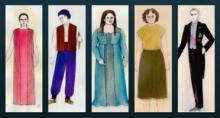
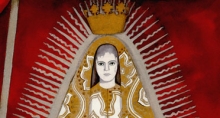
The UC Merced Library is involved in an ongoing project to digitize approximately 2,000 illustrations of costume designs by School of Social Sciences, Humanities and Arts Professor Dunya Ramicova.

Digital Management Plan Tool

Wed, August 13, 2014

Need to create a data management plan?
Use the
 DMP Tool, a service of CDL and the UC Curation Center.   


  • Free and open to anyone.
  • Guides you through the process of creating a data management plan to meet funder requirements.
  • Provides links to funder information, suggested answers, and data management resources.

Developed by the UC Curation Center, California Digital Library, in partnership with DataONE, Digital Curation
Centre (UK), Smithsonian Institution, UCLA Library, UC San Diego Libraries, University of Illinois, and University
of Virginia Libraries.


Research Week - Research Data Events - SDSC

Tue, February 26, 2013

Research Week - Research Data Events sponsored by the Library

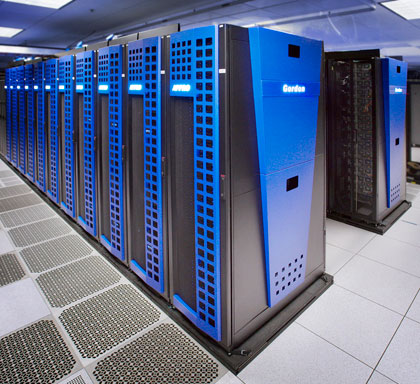
 The San Diego Supercomputer Center will be here to talk about their great tools for research data:


Looking for an inexpensive place to store your data or need a computing cluster for crunching data? The SDSC will be here to talk about their resources on March 5th from 12:00 - 3:00 in KL 260:

  • Overview of SDSC services and resources from 12:00 - 1:00
  • In depth discussion on HPC Compute resources from 1:00 - 2:00

Feel free to attend any or all sessions at the library (KL 260) on March 5th to learn more about these great research data solutions.

***Refreshments will be provided.***

For questions or to RSVP (no required but appreciated) please contact Susan Borda at sborda@ucmerced.edu

I look forward to seeing you there!

Research Week Events

Mon, February 25, 2013

Research Week - Research Data Events sponsored by the Library

 The California Digital Library and UC Berkeley ResearchHub will be here to talk about their great tools for research data:

  • Looking for a tool to help you with your grant’s data management plan? Find out about the DMPTool on March 4th from 9:30-10:15 in KL-260.

  • Need help with citing your data when you publish your research? Learn about EZID in March 4th from 10:30-11:00 in KL-260.

  • Do you have Excel spreadsheet that need metadata? Hear about DataUP on March 4th from 11:15-12:00 in KL-260. 

  • Would you like a tool for collaborating with your research team? The UC Berkeley ResearchHub team will be here to talk about the ResearchHub on March 4th from 12:00 – 1:00 in KL-260.

Feel free to attend any or all sessions at the library (KL 260) on March 4th to learn more about these great research data solutions.

***Refreshments will be provided.***

For questions or to RSVP (no required but appreciated) please contact Susan Borda. 

I look forward to seeing you there!

Pages

Subscribe to Digitization