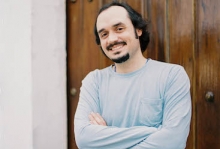
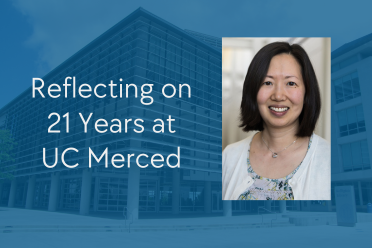
Emily Lin joined UC Merced July 1, 2003 after completing a Masters’ in Library & Information Science (LIS) at Drexel University. While she joined UC Merced to digitize collections from the Clark Center for Japanese Art and Culture in Hanford, she was deeply involved in establishing UC Merced Library services and infrastructure as one of the founding librarians.
Emily continues to envision a future for the UC Merced Library as a center for information access, including the important documentation of the Sierra Nevada-Central Valley region. The current NEH grant award is essential for building the Library’s capacity for archival storage, preservation, and use.
By the time we spoke with Emily, we discovered that she had reached her 21st work anniversary. Hear more about her initial draw to UC Merced and the valuable work she has done both locally and systemwide.
Emily Lin is our Director of Strategic Initiatives, Archives & Special Collections.
What brought you to UC Merced? Why the UC Merced Library?
The story behind this is: I met Brian Schottlaender, then the University Librarian at UC San Diego, when volunteering at ALA Midwinter in Philadelphia, where I was living and completing my MLIS. He mentioned a new UC campus would be opening and took a copy of my resume. I followed up with him after the conference and he introduced me to Bruce Miller, UC Merced Library’s University Librarian (UL).
Bruce described an amazing opportunity that combined my interests in digital collections management and East Asian studies and art. The Library had successfully applied for a three-year National Leadership grant from the Institute of Museum and Library Services (IMLS) titled Opening the Cultural Corridor. They were looking to hire an individual to manage the project. This work would involve digitizing museum objects from the Clark Center in Hanford and making those images accessible online.
I was also excited by the opportunity to be a part of building a new university and providing access to higher education in a region where there was a great need.
How would you describe those early years of establishing UC Merced’s academic library? What was exciting and/or challenging?
There were so many firsts! My first few weeks on the job I was putting together a 4x5 camera with a digital scanning back and learning to operate something I had never used before. I designed web pages for our first website and created the first letterhead for the Library. We set up a “digitization lab” at the warehouse in Castle, the former Air Force base in Atwater, where our HVAC system consisted of a swamp cooler.
Challenges abounded. In 2004, a few months after I arrived, there was a lot of discussion in the media about stopping the campus from opening. So even before the doors opened, there was a lot of uncertainty about whether or not UC Merced was even going to happen. Some considered it a boondoggle. There were lawsuits happening, trying to put the brakes on the campus being built.
However, Bruce Miller, our University Librarian, was always very positive. He said, ‘This is the University of California. This is a really important endeavor so the campus will open. We will find a way to succeed. It is too late to put the brakes on this campus.’ It was an interesting time!
Another challenge was taking on and being part of discussions and decisions that were not in my area of expertise. For instance, I didn’t know anything about how library spaces should be designed or how to set up an integrated library system (ILS). But I was part of all those conversations early on. There was a lot of learning the ropes which was great, but there was also so much to make sense of. We had to be bold and demonstrate some bravado. Everything was new and fresh. We were going to take risks, do our best, and figure things out.
Working with the Clark Center collection was an example of figuring things out. I realized early on that we had no content management system in place to house and organize digital files. Even though I was working with a museum curator and a photographer to digitize the art, I had to determine how we were going to record all of the data and make the digital collection available following the standards that had been outlined in the grant.
I spent the summers working with the photographer to take pictures of the museum objects and then the rest of the year working on processing the images, compiling the metadata, and figuring out how we were going to make these items digitally available.
I worked with folks from the California Digital Library (CDL) and especially UC Berkeley’s technical services and digital library program. They helped us a great deal; we were able to use a system Berkeley maintained to ingest digital images into Calisphere. Overall, it felt like we were stitching a lot of things (systems) together.
Figuring out how to meet all the grant requirements was also something new, especially at such a young campus. This work involved fulfilling all the financial and administrative requirements, not just the project goals. We were required to digitize over 400 paintings from the Clark Center and focused on the scroll paintings. We actually exceeded this goal and digitized many other three-dimensionals objects including baskets, ceramics and a bronze object over 1,000 years old.
The Clark Center was in the middle of an orchard, which presented challenges. We would have to work around the harvest schedule since the camera was sensitive to the vibrations from equipment, and any kind of shaking would be visible in the photos we captured. Sometimes when I was post-processing, I would notice a fly in the photo. We would return the next year and retake the photo(s).
I recall that it was tough attending IMLS sponsored-meetings and hearing from grantees at other institutions who had teams of people with specific expertise in metadata and technical systems. In contrast, there was one of me connecting with individuals from different areas and trying to put it together and make it happen. At the same time, there was support which I really appreciated, extremely helpful support both from colleagues in the Library and the UC system.
This was a challenging time but also an exciting time because I was always learning something new.
To what extent has the larger University of California Libraries system been influential or important to the work you’ve been able to accomplish?
We could not have stood up systems, made access to digital collections possible, or published finding aids without the California Digital Library (CDL) and the UC Libraries working together. The work we did with eScholarship and data curation, much of it was in collaboration with other partners in the UC Libraries system.
A lot of my work over the years has been to help develop frameworks that support shared infrastructure. Even though eScholarship was available, our uses of it informed how that system developed and what it would support. For example, since we were not accepting print dissertations and theses, we became a driver behind an electronic dissertations and theses (ETDs) workflow in eScholarship.
What would you highlight as a major accomplishment (or opportunity) during your professional career?
Working on the Next Generation Technical Services (NGTS) initiative was significant though sometimes frustrating. Yet, we still benefit from the outcomes of that work which took multiple years to accomplish.
I chaired the New Modes for Access Task Group. As a result of that work, we have access to ArchivesSpace and a shared DAMS infrastructure supported by CDL. The Guidelines for Efficient Archival Processing in the University of California Libraries (2012) stemmed from our recommendations. That document has been used by colleagues in the system and more broadly in the profession. Even the shared ILS, launched in July 2021, was a recommendation out of NGTS even though it took much longer to come to fruition. It is rewarding to see that work that took place over a decade ago still being used.
How has your work evolved at UC Merced in the past 21 years?
There have definitely been shifts in my focus -- whether on local needs and projects or times when more of my attention was focused on systemwide work like NGTS and the digital infrastructure development. Some of the shifts were intentional and others came as needs arose.
As more systems were established, we were able to do more. With a more mature digital infrastructure, we were able to bring in some physical archival collections to UC Merced. Dunya Ramicova’s costume design collection was one of the first collections that we made accessible through the new digital assets management system (DAMS).
But then as we are bringing in more physical collections, we’ve had to turn to the problem of space. Now we are looking to expand the physical infrastructure, increasing our capacity to house collections.
What do you (have you) enjoyed most about your work?
If I were to be honest, it is still the people I enjoy the most. I very much admire and appreciate the people that I work with. My colleagues in the UC system are really smart individuals.
At the end of the day, I find it most rewarding to know that my work benefits students and supports our researchers.
You have created a long term plan for establishing a Sierra Nevada - Central Valley Archive and were instrumental in securing a $750,000 Infrastructure & Capacity Building Challenge Grant from the National Endowment for the Humanities (NEH) grant in partnership with the Center for the Humanities. What are some short-term and long-term outcomes you hope to see accomplished?
There are the tangible outcomes--functional spaces that support the use of our archival collections and future collections. All of the components of those spaces are important. With them, we can provide a good environment for storage and preservation, and a dedicated area where researchers can come and use the collections. I’m probably most excited about the potential for a learning space where our students can engage with the collections. This space is where we can also showcase materials to additional audiences.
But we also have a broader vision to be a center where we can share expertise and learning opportunities with others in the region, including those from historical societies and museums. These organizations often have limited staff and resources or function primarily with volunteers.
Our idea would be to serve as a place where we can share knowledge and participate in a shared mission to preserve and promote the history of the region. Once we have these functional spaces and can develop our own staffing and resources, we can pursue these more lofty goals.
There’s a lot more work that we need to do. It’s not just creating the physical infrastructure but also the program behind Archives and Special Collections.
Generally, what is the value of an archive? Specially, why would a Sierra Nevada - Central Valley archive be important to our campus, community and larger region?
This region of the Sierra Nevada - Central Valley (and the San Joaquin Valley in particular) is really important to the rest of the state and even globally. There is uniqueness in terms of the agriculture that happens here, the biodiversity, and the history that may not be well understood. I think it’s important to be able to save and share this knowledge.
With an archive you are preserving the documentation, the evidence, the primary source materials. That evidence is foundational because it is not someone else’s interpretation. The records of the climate, the environment, the region’s events (and so much more) could be contained in an archive.
I think our role is to save, organize, and make this documentation available so it can be used, mined, and referenced by generations to come.
When you aren’t working, what activities do you enjoy the most?
When I’m not working, I try to spend as much time as possible with my family. Those activities have changed and evolved as my kids have grown, whether it’s building Lego sets, baking and, more recently, completing 1,000-piece jigsaw puzzles.
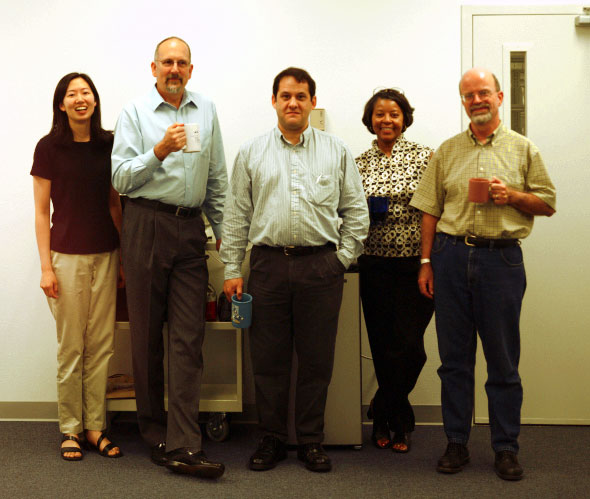
L:R Emily Lin, Bruce Miller, Donald Barclay, Joy Parham, and Jim Dooley; founding staff at the UC Merced Library. This is the first photo Emily took using a 4x5 camera with a Betterlight scanning back, in August 2003.
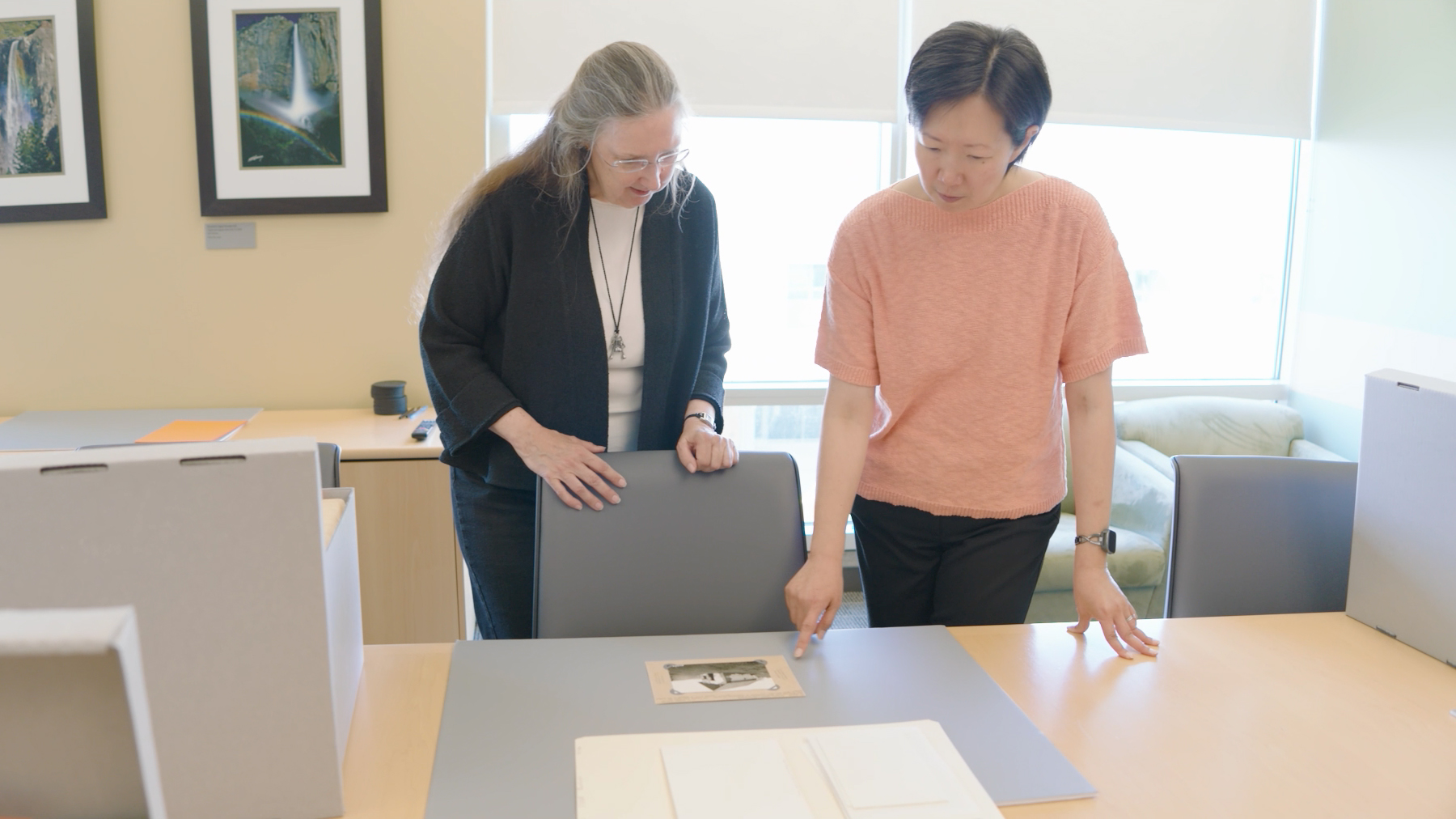
Emily Lin (right) Director of Strategic Initiatives, Archives & Special Collections, UC Merced Library with Kathleen Hull (left), Professor, Emerita, Anthropology & Heritage Studies, UC Merced examining primary source materials.